If you’re not subscribed to my newsletter (you can do so on the home page of my website), or it doesn’t open in your email program, here’s a link to the latest newsletter with important news about forthcoming appointments.
January 2019 Newsletter
January 25th, 2019Healing Hands Network – Sarajevo, 8th to 22nd September 2018
September 4th, 2018If you wish to receive brief updates of my voluntary work you can sign up here
Healing Hands Network in Sarajevo
October 2019 – update
I went to Sarajevo again in September 2019 and found it an even more worthwhile experience. It was wonderful to see some of the same clients and an improvement in their demeanour. It was heartening to hear that there are a some who have reached level 3 Reiki and some who have had their induction in Massage and Reflexology from two tutors with Healing Hands Network. That’s real progress for a sustainable future – for local therapists to be able to provide therapies for people who continue to bear the scars – mentally and physically – of the conflict.
I will be raising funds to go again in 2020. Firstly through offering Thai Yoga Massage treatments during October and November 2019 for a donation towards this work.
July 2018
I have funded my travel costs and am now seeking to raise funds to support the work of HHN at the clinics in Sarajevo and surrounding cantons and to enable further training for local therapists. This will ensure that the benefits of holistic therapies are sustainable and available in the long term.
I completed my HHN induction in July and was invited by HHN to spend a week at a Family Activity Breaks (FAB) camp at PGL Caythorpe Court delivering treatments to bereaved military families, as preparation for my work in Sarajevo.
Please support me in the worthwhile work provided by HNN by visiting my fundraising page (tba)
I appreciate your support.
Background
Healing Hands Network has been working in Sarajevo since 1996 to help and give hope to the people who lived through the Bosnian conflict and suffered physical and psychological trauma
The siege of Sarajevo, which set neighbour against neighbour, lasted for 1,425 days between 1992 and 1995
500,000 inhabitants were trapped without food, power, communications or healthcare. Thousands of grenades fell – 12,500 citizens (including 1,601 children) were killed; 61,000 (including 14,946 children) were wounded.
In concentration camps, many men, women and girls were brutally raped, some repeatedly
The aftermath continues to affect citizens physically and psychologically
Holistic approaches to healing are accepted unconditionally in Bosnia and Herzegovina so the therapeutic benefits are greatly accentuated.
Many clients say how much better they are feeling; they are sleeping better, their continual aches and pains are relieved, they have an improved quality of life and increased optimism and hope.
For some clients, who might also be caring for someone else who is suffering, it could simply be an hour for them to reflect and have some peace.
Treatments and training
- 34 therapists gave ± 2,000 treatment sessions in 2017 in Sarajevo, at the HHN clinic and 6 outreach centres
- HHN trainers have delivered Reiki levels 1 and 2 and 3 Workshops and massage techniques for self help
- further training in holistic therapies by HHN is planned to empower clients to help themselves, families and friends
- several local share groups have been set up to combine all techniques that HHN has taught them, including Emotional Freedom Technique and Heart Focused Breathing and gentle exercise.
- clients in Sarajevo come from associations that operate support groups, such as Concentration Camp Union, Women Victims of War, Mothers of Srebrenica and Civil War Victims. These associations select their most needy members for HHN therapies between May and October each year.
- each HHN therapist does a two-week tour of duty
Article in the Bramley newspaper on Auricular Acupuncture
December 21st, 2016PRICK UP YOUR EARS!
Jacky Huson at Touch Therapy has added ear acupuncture to her range of therapies. She was inspired by Anna Venables founder and owner of Microsystems Therapies and Training who trained with John Tindall of Yuan Clinic and Traditional Medicine College in London – who coincidentally is the son of a very good friend of Jacky’s husband.
Similar to the way that reflexology reflects the body systems in the feet and hands, ear acupuncture is a form of microsystems acupuncture rooted in 2,500 year-old Traditional Chinese Medicine and more recently Paul Nogier’s concept of the ear having an anatomical correlation to an inverted foetus.
Jacky trained with Anna who has devised a protocol to stimulate defined points on the ear with short very fine acupuncture needles. This is designed to work in conjunction with other therapies such as massage and reflexology to normalise the nervous system particularly where a person is suffering stress, anxiety or depression. These conditions accounted for 39% of all work-related illnesses in 2013-14 and WHO estimate that 70-90% of doctor’s visits are for stress-related issues.
Harmful or negative stress – distress – causes damage to our bodies. The immune, respiratory and circulatory systems can be compromised which obviously impacts on our well-being. Holistically, a person may consider their lifestyle, exercise and diet as well as seeking physical or cognitive therapies.
Jacky practises massage and reflexology and is now delighted to be able to offer clients the added benefits of ear acupuncture.
Local Therapists wins award
October 12th, 2015

Jacky Huson of Touch Therapy and her colleague Jayne Newsome who together started the Federation of Holistic Therapists Local Support Group in Nottingham in 2007 have won an award for ‘Joint Co-ordinator of the Year’. Jacky received her award from Vice President Paul Battersby at the FHT Annual Congress dinner in the Holiday Inn, Stratford on Avon on 5th September, when 3 group members joined her to celebrate.
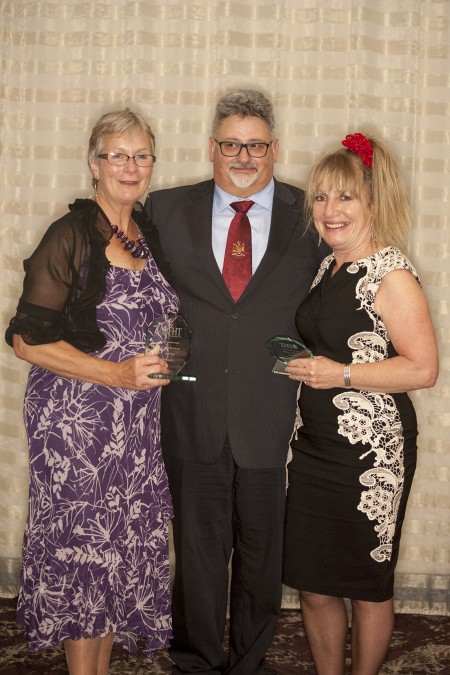
The group meets every other month when they invite industry experts to share their expertise. In addition they have arranged outings and local training, provided therapists for local pamper events and organised the Chill Out Zone at Southwell Folk Festival from its inception.
Jacky says “It is also a tribute to the continued support of members who encourage us to keep running an active group, attendance at which helps with their Continuing Professional Development. Earning CPD ‘points’ is essential for therapists to maintain good professional practice, particularly now that FHT, as the biggest professional complementary therapy organisation, is accredited by the Professional Standards Authority.
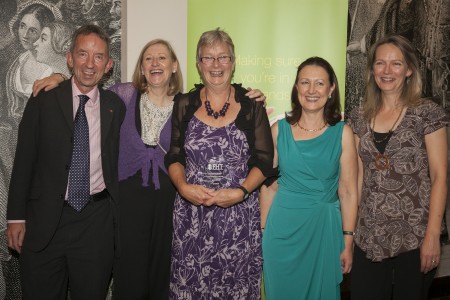
Jon Critoph (FHT Outreach Manager), Caroline Bradley, Jacky, Ros Elderkin, Julie Payne
We both fervently believe that having such a network is very important for therapists to feel part of the bigger organisation through this local representation.
To be able to regularly meet other like-minded therapists, share information and continue our professional development in a convenient location, helps us feel supported and less isolated, as many of us may work alone.”
Citation from Paul Battersby – Vice President of FHT
“This award is for an LSG Coordinator or Joint-Coordinators who have supported the FHT, local like-minded members, other therapists and the public, through meetings, events and other activities.
It goes without saying that ALL of our coordinators do a fantastic job, but this award was introduced so that those attending local meetings could show their gratitude for the support their own LSG coordinators provide, all on a completely voluntary basis.
From the very first LSG meeting held by Jacky and Jayne back in 2007, the group has continued to enjoy a wide range of talks, activities and support provided by these two coordinators.
Just to give you a flavour, they have arranged for industry experts to present to the group; shared and celebrated the achievements of individual group members; arranged treatment swaps; organised therapy taster sessions at local events and festivals; provided talks and demonstrations at local colleges and libraries; organised trips to exhibitions and conferences, and training opportunities especially for the group; and organised social events, including trips to a meditation garden and an annual Christmas meal.
As practising therapists in their own right, Jacky and Jayne are both highly motivated and an inspiration to the group.”
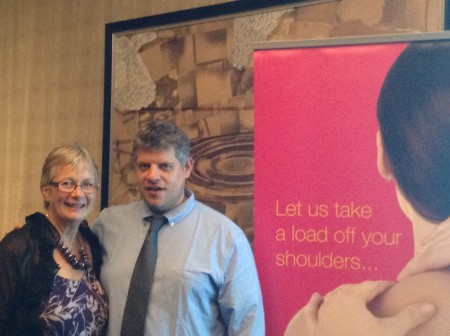
Jacky with Simeon Niel-Asher
Jacky was delighted to meet Simeon Niel-Asher whose innovative technique for shoulder conditions is highly acclaimed.
huge bodybuilder worship k_pa testosteron 2 a day workouts bodybuilding
Therapies at the ‘Find Your Sense of Tumour’ Conference – November 2014
March 15th, 2015Seven young people are diagnosed with cancer every day in the UK. Teenage Cancer Trust, aware that “having cancer at a young age comes with its own particular set of challenges”, provides “services which put the needs of young people first and allow them to face those challenges together”
About 170 young people between 18 and 25 were invited by the charity, to their Find Your Sense of Tumour national conference in November 2014 – “a mix of inspirational presentations, fabulous therapies and great social activities” at Center Parcs in Sherwood Forest, Nottingham – transformed into a Winter Wonderland, complete with real reindeer and singing Christmas Tree!
Recent conferences have been funded by the Queen’s Trust which was set up in 1977 with donations from the public to celebrate the Queen’s Silver Jubilee to benefit young people helping each other.The charity also received a huge boost in May 2014, following Stephen Sutton’s £5m legacy from his bucket list activities right up to his death.
Since 2004, Virginia McGivern Complementary Therapy Nurse Specialist based at Queen’s Medical Centre in Nottingham has organised therapists from all over UK who volunteer their skills and time to give complementary therapies to the young people during the conferences. In her job, she offers “TLC, pain relief and psychological support to the young people and their families during very stressful times.”
This objective is transported to Center Parcs where young people can book for a 30 minutes’ session in 3 villas which are transformed into warm, welcoming ‘therapy centres’. Alternatively they can ‘drop-in’ to the Chill Out room (this time a ‘grotto’ with ice thrones, stalagmites and stalagtites!) at any time during the weekend where a number of therapists are always on duty.
The young people who usually come in a group with staff from their treatment centre, have the opportunity to try complementary therapies, often for the first time, and relax in a safe environment . The young people appreciate special ‘time-out’ and the caring touch of whichever therapy they choose.
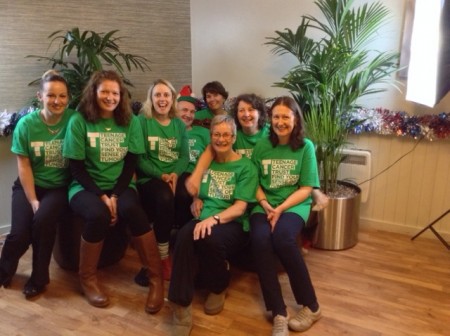
In 2014, 11 therapists – 5 whom are FHT members – and most of whom stay for the whole weekend, provided treatments ranging from acupressure, acupuncture, aromatherapy to reiki and reflexology. Some work regularly with cancer patients in hospital settings, others are experienced therapists who are passionate about the benefit of complementary therapies. It had been a rush get the DBS checks done in time and some regular volunteers were bitterly disappointed to miss out.
Therapists agree it is a truly inspirational weekend to work closely with young people who face a bigger challenge than most of us face in our whole life. It is humbling to see how they cope with the huge physical and emotional impact of cancer with a stunning maturity and enjoy themselves during this unique weekend.
We look forward eagerly to the next conference in July which will be for 14-18 year olds at a venue in Staffordshire.
Highlights are videoed and can be viewed at https://jtvcancersupport.com/channel/fysot/
Article submitted by Jacky Huson to International Therapist – professional magazine for the Federation of Holistic Therapists.
rx steroids buy klonopin online
powerlifting and bodybuilding glucose 105 black women bodybuilders nude
Index to archived articles
September 1st, 2009
|
Dedicated follower of fascia – helping you to unwind Excellence is doing ordinary things Aim for perfect – settle for ‘good enough’? Back to nature Music as part of massage therapy A taste of my own ‘medecine’! Emotional Intelligence |
September 2009 August 2009 July 2009 June 2009 May 2009 April 2009 March 2009 |
|
Kindness |
February 2009 |
|
Natural ‘highs’ boost your immune system |
January 2009 |
|
Remedial, therapeutic, relaxing – the different faces of massages |
December 2008 |
|
Do something about it – feelings buried alive never die |
November 2008 |
|
Plan to do nothing! – prepare for your treatment |
October 2008 |
|
Less is more |
September 2008 |
|
Being ‘body-aware’ allows choice |
August 2008 |
|
Letting Go’ – of tension |
July 2008 |
|
Hold your head up high –check your posture |
June 2008 |
|
Home is where the heart is |
April 2008 |
|
The door to happiness opens outwards – open up your mind and body |
March 2008 |
|
Love – can affect your well-being |
February 2008 |
|
Peace begins with a smile |
January 2008 |
|
For it is in giving, we receive |
December 2007 |
|
Purity of mind depends on purity of food |
November 2007 |
|
Slow down and enjoy life |
October 2007 |
|
Feeling ‘under the weather’ let the sun shine in |
September 2007 |
|
Time and tide wait for no man – act when the time’s right |
August 2007 |
|
The less routine, the more life |
July 2007 |
|
Don’t fear change, embrace it |
June 2007 |
|
Balance and health |
May 2007 |
|
Sleeping is not time-wasting |
April 2007 |
|
Hoot if you hate noise pollution |
March 2007 |
|
Food, nutrition and health |
February 2007 |
|
Massage rocks – Hot Stone therapy |
December 2006 |
|
Be sociable, treat yourself, friends and family |
November 2006 |
|
These feet are not only made for walking |
October 2006 |
|
Ooh my back |
September 2006 |
|
Aromatherapy, more than a scented massage – the 3 ‘P’s |
August 2006 |
|
The Consultation Process |
July 2006 |
|
The Healing Crisis |
June 2006 |
|
Take a breath – be breath-aware |
May 2006 |
|
Stretch out – |
April 2006 |
|
A NEAT way to exercise |
March 2006 |
|
‘Chill out and relax |
February 2006 |
|
Give your body a break from stress |
January 2006 |
|
Keep your water levels topped up |
December 2005 |
|
How can Holistic Therapies help me? |
November 2005 |
Dedicated follower of fascia – helping you to unwind
September 1st, 2009Fascia is a tough seamless tissue that holds us together, somewhat like a body stocking that covers and connects muscles, organs and skeletal structure. There are three layers – superficial which determines the shape of our body; deep which interpenetrates and surrounds the muscles, bones, nerves and blood vessels of the body; and visceral which surrounds organs within their cavities.
If the deep muscular fascia becomes restricted due to injury, stress, inflammation, trauma (physical or emotional) or poor posture, it can lead to myofascial pain, affecting our flexibility and it can impair the effective exchange of cellular nutrients and wastes.
Fascia is highly adaptable – stretching to accommodate, for example, pregnancy – but if subjected to prolonged tension, it can become thicker and less extensible. Because it is interconnected, the effects can be felt distant from the point of trauma – imagine pinching up the fabric of a stocking and seeing the fibres radiating out in wrinkles. However because it is thixotropic (it can change from solid to more liquid gel consistency) special fascial remodelling techniques can reverse this thickening and ’unwind’ the fascia.
These soft tissue manipulation techniques need initial gentle palpation and then focussed pressure and can constitute a whole treatment. It can also be very beneficial if carried out for a few minutes prior to applying oils for a massage. The therapist’s hands need to ‘engage’ with the underlying fascia and slowly ‘sink in’ to encourage gentle movement and heat to the area.
As a client you may experience a ‘softening’ of that muscle area, some heat, even twitching and a physical or mental sensation of ‘unwinding’. It may not seem a very ‘active’ technique but as with any focussed bodywork, it can be therapeutic and beneficial.
Excellence is doing ordinary things
August 1st, 2009Last month I proposed that while we may not be able to enjoy ‘perfect’ health we might need to challenge ourselves not to get stuck in ‘satisfice’ by accepting that our condition has become our ‘ordinary’ state. “Perfection consists not in doing extraordinary things, but in doing ordinary things extraordinarily well”[1].
‘Ordinary’ is an emotionally charged word and can be defined as ‘usual, normal’, or even ‘second-rate, inferior’. Do we really want to settle that in terms of our health?
“The ordinary acts we practice every day at home are of more importance to the soul than their simplicity might suggest”.[2] Elements of Complementary Therapies can be ‘ordinary’ in that they need not be complex or involve complicated procedures and there are a number of self-help remedies which you can practise at home. There are a number of goods on the market, such as pre-mixed aromatherapy products and Bach Flower Remedies which can safely be administered, providing the precautions and instructions are followed. Or perhaps an holistic health assessment might highlight that you may need to drink more water regularly to keep cell tissues hydrated and able to perform their function more effectively and efficiently.
In the holistic therapy clinic, some bodywork techniques may appear to be unspectacular or ‘ordinary’, but they can have tangible effects. For example, something as simple as a focussed, still pressure on the right place of a tense muscle gradually allows the muscle fascia to relax and ‘unravel’ knotted tissues.
Complementary therapies do need to be carried out professionally by a qualified therapist (for example, see www.fht.org.uk or www.naturaltherapypages.co.uk) and with an ‘extraordinary’ level of focus, energy and engagement in order to be effective.
“If you are not willing to risk the unusual, you will have to settle for the ordinary”[3] – if you haven’t tried any complementary therapy before – ‘risk the unusual’, and be prepared to be surprised how the apparently ‘ordinary’ can yield ‘extraordinary’ benefits.
[1] Angelique Arnauld
[2] Sir Thomas More
[3] Jim Rohn
Aim for perfect
July 1st, 2009Psychologist Herbert Simon coined the phrase – ‘satisfice’ – a combination of satisfy and suffice. This would probably involve ‘going with the flow’ which tends to mean we worry less rather than agonising over the very best option or looking for something that doesn’t even exist – the perfect job, the perfect house, the perfect partner.
We might hang onto an unsatisfactory life situation simply because we’ve invested a lot of time and energy in it. It might be better to make a choice, even if the choice is to change nothing, rather than get stuck in the decision-making process and worry about all the possible – usually negative – outcomes. Usually once a decision is made intuitively, our energies become focussed into making that decision the ‘right’ one for us.
I suspect this could also relate to our health. We may have a chronic condition that we’ve got used to and have developed coping mechanisms to function adequately. We might be reluctant to change our lifestyle or have become ‘stuck’ in ‘satisfice’. In the case of our health, I would argue that it’s worth not settling for ‘good enough’ but to consider making a decision to change – it may be too late to reverse the effect of some conditions, but we may well be able to ease the symptoms, even if we know that we’ll never achieve ‘perfect’ health. Surely if the decision is to eat more healthily, drink more water, take more exercise or have a regular massage then you will feel better and you’ve nothing to lose – except weight perhaps!
The lifestyle assessment before your first holistic treatment is a good opportunity to assess what changes you might like to make. Some clients then find it useful to use the therapist as their external ‘conscience’ to provide useful feedback and help them implement and maintain those changes.
Back to Nature
June 1st, 2009After yet more back-breaking work my attractively designed raised vegetable beds are now in place. I’m looking forward to reaping the benefits – not only harvesting and eating my crops, but also the whole experience of sowing, tending and being close to nature in my small garden from where I can enjoy apples ripening, dappled sunlight through silver birch leaves and a laburnum dripping with bright yellow flowers.
Being in an environment of trees and plants can be physically and emotionally beneficial. A mature leafy tree produces as much oxygen in a season as ten people inhale in a year and certain trees produce beneficial essential oils such as Tea Tree and Pine, or form the base for certain medicines such as aspirin and quinine.
The Tree Council[1] organised a ‘Walk in the Woods’ month in May to attract people who rarely, if ever, visit woods, possibly motivated by research[2] in Japan which showed that ‘forest bathing’ or ‘shinrinyoku’ measurably reduces stress levels, improves the immune system and regulates pulse and blood pressure. Being surrounded by the sights, sounds, smells and textures of a forest can also help to clear the mind. ‘Green Gyms’ [3],run by BTCV, is an initiative to improve well-being through involvement in practical conservation activities – some GP’s are advocating this project to patients suffering with mild depression.
Office workers have reported that they felt healthier and had fewer sniffles and sore throats when they have plants in their office. As well as boosting oxygen levels, plants are purifying and help clean pollutants from the atmosphere ‘tainted’ by photocopiers and computers. Apparently, Sansevieria (Mother-in-law’s tongue) is particularly suitable for busy people because it is indestructible and needs little watering! Furthermore, like Aloe Vera, the sap of the ehrenbergii species has healing qualities.
I’m thinking of offering, weather permitting, a brief, pre-treatment stroll in my garden to enhance the benefits of a massage!
[1] http://www.treecouncil.org.uk/?q=walkinthewoods
[2] http://www.japanfs.org/en/pages/025839.html
[3] http://www2.btcv.org.uk/display/greengym
is award winning hyphenated buy anavar uk steroide turinabol achat